


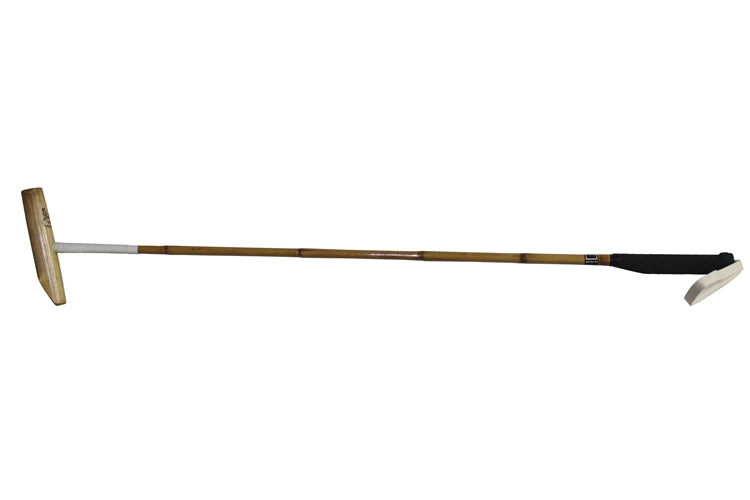



FREE SHIPPING $350+
Free shipping on orders of $350+ Restrictions Apply.
No Code Needed


The right polo saddle does more than keep you in position, it protects your horse's back, supports your swing, and holds up through fast turns, bump-and-ride plays, and back-to-back chukkers. At Tato's Mallets, every polo saddle in our collection is selected specifically for polo performance: the tree, the leather, the panel system, and the fit all have to work together the moment the whistle blows. If you are choosing a polo saddle for the first time, upgrading from an older one, or kitting out a new string of horses, this guide covers what actually matters and what to look for before you buy.
 Polo is not trail riding. It is not a dressage test or a hunter round. The demands on a polo saddle are specific, and a saddle built for another discipline will almost always fall short on the polo field.
A polo player needs to be able to swing a mallet at speed in both directions, lean out of the saddle during a ride-off, and shift weight quickly as the play changes. That means the saddle needs a relatively flat seat with minimal knee roll, you are not locking yourself into a fixed position the way a dressage rider would. At the same time, the saddle must be stable enough to support a rider through full-speed contact and abrupt direction changes without twisting or rocking on the horse's back.
The horse's needs matter just as much. Polo ponies carry a rider through multiple chukkers, often in a single afternoon. A saddle that bridges the spine, sits too narrow over the withers, or restricts shoulder movement will cause soreness, stiffness, and long-term muscle damage. A good polo saddle distributes the rider's weight evenly across a well-padded panel surface, clears the withers, and does not interfere with the scapula as the horse gallops and turns.
A polo saddle built for polo is the only saddle that does both jobs at once.
 The tree is the internal frame of a saddle, and in polo, it carries the whole structure of the ride.
At Tato's Mallets, our American Polo Saddle in Buffalo leather is built on a laminated wooden tree reinforced with steel straps and a double-strength front arch. That front arch is not a small detail. During a bump-and-ride or a fast turn, the front arch absorbs lateral stress that would crack or warp a lighter frame. The steel reinforcement ensures the saddle holds its shape through high-intensity play, chukker after chukker, season after season.
A tree that fails, or flexes in the wrong places, does not just wear out faster. It changes the way the saddle sits on the horse's back, creating pressure points where there were none before. A well-engineered polo saddle tree maintains its geometry through the life of the saddle, so the fit you get on day one is still the fit you have two years later.
The tree also determines saddle size. Tato's Mallets carries polo saddles in 18" and 19" sizes, with custom sizing available on request. Saddle size refers to the seat length, the distance from the nail at the front arch to the center of the cantle, and getting this right affects both rider comfort and balance.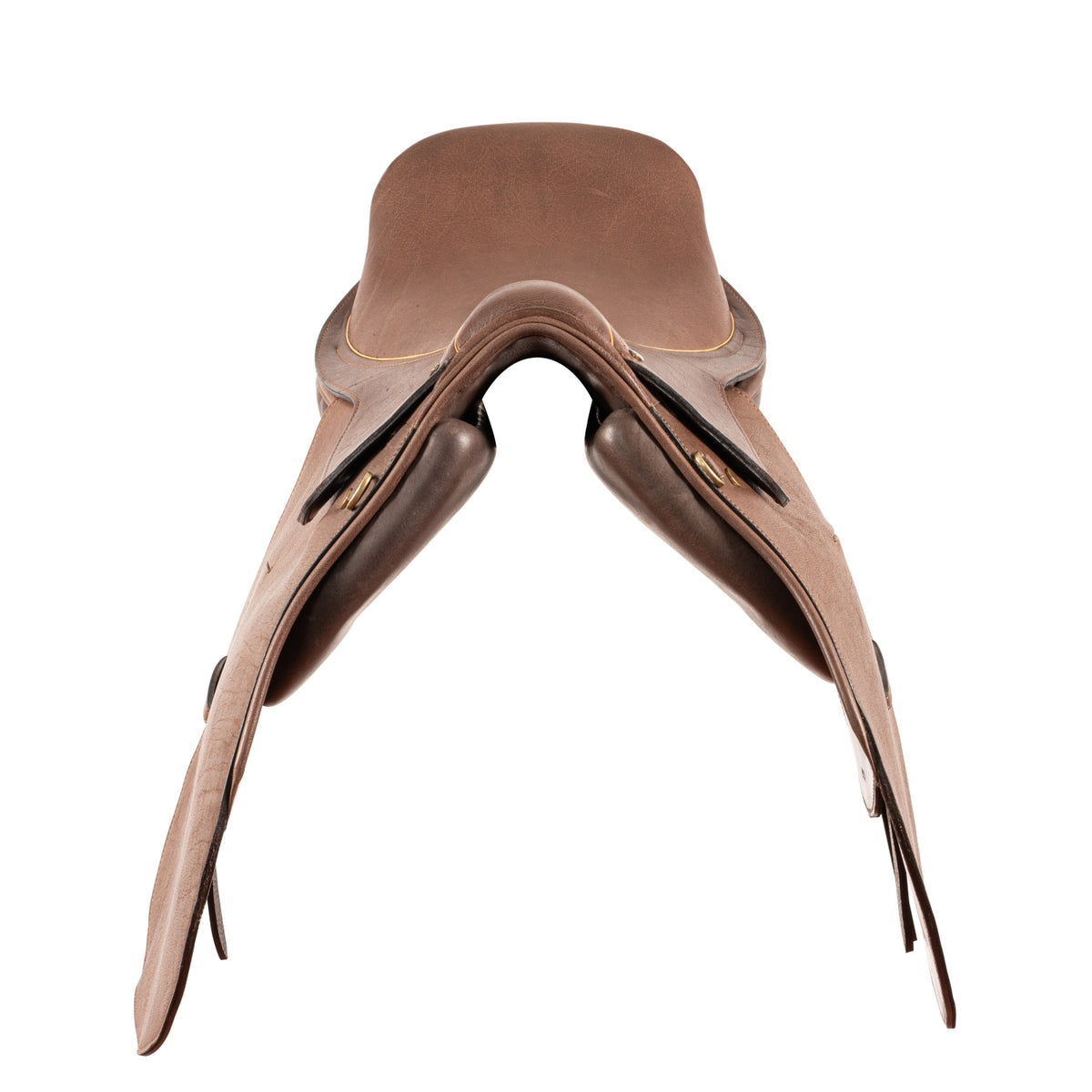
Leather is not just an aesthetic choice in a polo saddle. It determines grip, durability, break-in time, and how the saddle performs in heat, rain, and the consistent abuse of competitive play.
The buffalo leather used in the TATO'S American Polo Saddle is chosen for its density and grip. Buffalo leather is thicker-fibered than standard cowhide, which means it provides a firm, confident feel in the seat without requiring heavy conditioning to stay supple. The Havana Brown finish gives the saddle its characteristic rich tone, and the extra thick buffalo billets, the straps that attach to the girth, are a direct response to the stress polo girths experience during a match.
Full-suede options, like those found in the Ainsley MVP Polo Saddle Series 2, offer a different texture advantage. Full-grain rough-out leather provides exceptional grip while being significantly more durable than traditional suede panels. Players who have ridden in both often note that rough-out leather holds its texture longer through wet seasons and repeated cleaning, maintaining grip quality well into the life of the saddle.
The right leather choice depends on the player's priorities: buffalo leather for durability and firmness, full-grain rough-out for grip and longevity, and suede for softness and close contact feel.
What Is the Difference Between Wool-Flocked Panels and Foam Panels in a Polo Saddle?
Panel technology is where polo saddle fitting gets specific, and where the wrong choice causes real problems for the horse.
Panels are the padded underside of the saddle that sit against the horse's back. Their job is to distribute the rider's weight across the back muscles on either side of the spine while keeping the saddle clear of the vertebrae themselves. In polo, horses carry the same rider across multiple chukkers and are often used in back-to-back chukkers during a tournament, poor panel contact compounds into real soreness over a season.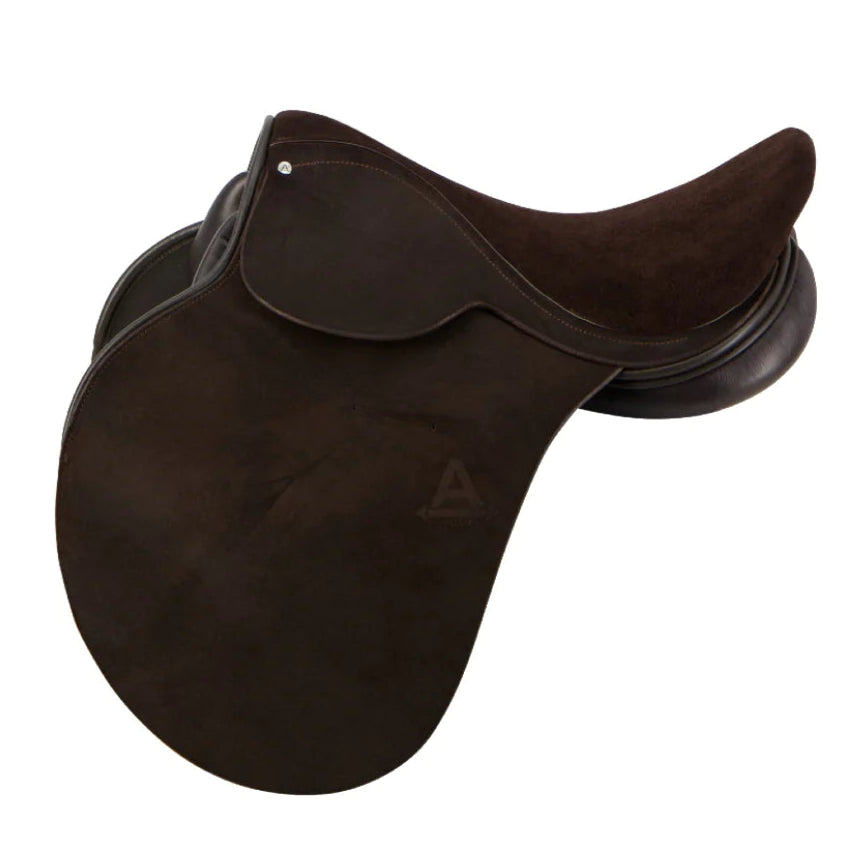
The Ainsley MVP Polo Saddle Series 2 offers two panel options, and the difference between them matters:
|
Panel Type |
Best For |
Adjustment |
Key Benefit |
|
Wool-Flocked Panels |
Players who want a precision fit |
Can be adjusted at any time by a qualified fitter |
Accommodates changes in the horse's weight, muscle development, and seasonal condition |
|
Freedom Foam Panels |
Players with multiple horses or limited fitter access |
No adjustment required |
Fits a wider variety of back shapes; combines the best of Slimline and Super-Slim designs from Series 1 |
Wool-flocked panels are the industry standard when precise saddle fitting is the goal. A qualified saddle fitter can add or remove wool to customize the contact surface, compensating for a horse that has gained muscle through training or lost condition during a winter rest. For players with one or two horses they ride regularly, wool flocking gives the most control over how the saddle sits.
Freedom Foam panels are the practical choice for players with a larger string or those who play different horses across a season. The foam's shape provides more trapeze space and improved scapular freedom, the shoulder blade can move fully forward and backward without the panel creating a friction point behind it. Freedom Foam panels do not require regular adjustment, which makes them a consistent, low-maintenance option.
Neither panel type is universally better. The right choice depends on the horse, the player's schedule, and whether a saddle fitter is available.
Fitting a polo saddle to a horse is not the same as choosing a size off a rack. Horse conformation varies significantly, wither height, back length, shoulder angle, and topline shape all affect how a saddle sits.
Here is what to check before committing to a polo saddle:
Wither clearance. The front arch must clear the withers by at least two to three fingers when the saddle is placed without a pad and girthed. If the arch sits on or near the withers, the saddle will pinch under the rider's weight and cause discomfort and injury over time.
Panel contact. Place the saddle on the horse's back without a pad and run your fingers along both panels from front to back. You should feel even pressure along the full length of the panel. Bridging, where the panel only contacts the front and back but lifts away in the middle, concentrates weight at two points rather than distributing it, causing soreness at the contact zones.
Shoulder freedom. Watch the horse walk and trot with the saddle girthed. The panel should not restrict the shoulder blade's rotation. A saddle placed too far forward is one of the most common fitting errors in polo.
Saddle balance. When viewed from the side with a rider in the seat, the lowest point of the saddle should be at the center of the seat, not tilted toward the pommel or cantle. A saddle that tips backward forces the rider behind the motion; one that tips forward drives the rider onto their thighs.
Girth fit. Polo girths and the billets they attach to are under significant tension during a match. The billets should align with the horse's natural girth groove, typically behind the elbow, to prevent forward or backward saddle migration during play.
Tato's Mallets stocks polo saddles with stainless steel stirrup safety bars across all models, an additional security feature for riders whose foot might twist in the stirrup during a bump or fall.
Every polo saddle at Tato's Mallets is built or selected against a single standard: it has to perform in a real polo match, not just look good on a rack.
The TATO'S American Polo Saddles are handcrafted in Argentina, where the tradition of high-performance saddle making for polo has been refined over generations. Skilled Argentine saddlers shape and finish each leather and suede component by hand, with hand-placed stitching and corrosion-resistant hardware across every model. The wooden tree in each saddle is individually engineered for balance, stability, and comfort, it is not a mass-produced component sourced from a catalog.
For players who want a higher tier of performance and adjustability, the Ainsley MVP Polo Saddle line represents a different level of construction. Developed by Ainsley Saddles specifically for polo, the Series 2 is crafted from carefully selected hides and finished in full-grain rough-out leather, a material that outlasts traditional suede through the wear patterns of competitive polo. The addition of Tack Room Changeable Girth Points in the Series 2 allows riders to adjust girth placement without returning the saddle to a fitter, a practical feature for players who rotate horses frequently.
From training saddles to match saddles, the Tato's Mallets collection is selected with the same question in mind: will this saddle hold up when the game gets fast?
A polo saddle takes more abuse per hour of use than almost any other equestrian saddle. Dirt, sweat, rain, and the repeated stress of match play accelerate wear, but consistent basic care extends the life of any saddle significantly.
After every match or schooling session:
Wipe down the leather with a damp cloth. Remove sweat and dirt before they work into the grain. Dried sweat is acidic and breaks down leather fibers over time.
Allow the saddle to dry at room temperature. Never dry leather near a heat source, it draws out natural oils and causes cracking.
Condition the leather every few sessions. Conditioning prevents dryness and maintains the suppleness of the leather, especially in the billets where flex stress is highest.
Check the stitching and hardware after each use. Polo puts specific stress on billet stitching, girth loops, and stirrup bars. Catching a loose stitch early prevents a failure during play.
Store the saddle on a proper saddle rack. Storing a saddle over a fence rail or door edge distorts the panels over time.
For suede and rough-out leather components, avoid water-based cleaners that can mat the nap. A soft brush restores the texture of suede; rough-out leather benefits from a periodic brushing as well.
 Tato's Mallets is based at 11496 Pierson Rd C-1, Wellington, FL 33414, the center of North American competitive polo, and ships polo saddles worldwide to players, teams, and clubs across more than 50 countries. The full polo saddle collection is available to browse at tatosmallets.com/collections/polo-saddles-1, where you will find the complete range from the TATO'S American models to the Ainsley MVP Series.
For players who want to see what else Tato's Mallets carries beyond saddles, polo mallets, polo bridles, polo bits, polo helmets, polo boots, polo knee guards, polo gloves, polo equipment bags, and custom team apparel, the full product range is at tatosmallets.com/collections/all.
Follow Tato's Mallets on Instagram at @tatosmallets for new arrivals, field photos, and polo equipment updates.
A polo saddle built for polo is the difference between a horse that arrives at the fourth chukker fresh and one that arrives sore.
Polo saddles are not interchangeable with general English saddles. The flat seat, minimal knee roll, and stable tree design are specific to the demands of polo play.
The tree is the foundation. A laminated wooden tree reinforced with steel straps and a double-strength front arch is what gives a polo saddle its durability and stability across a season.
Leather choice affects grip, break-in time, and longevity. Buffalo leather offers density and firmness; full-grain rough-out leather provides exceptional grip that outlasts traditional suede.
Panel technology determines horse comfort. Wool-flocked panels offer precision adjustability; Freedom Foam panels fit a broader range of horses with no fitter adjustment required.
Fit is the most important factor. Wither clearance, panel contact, shoulder freedom, and girth alignment must all be correct before a saddle goes into match use.
Every polo saddle at Tato's Mallets is selected for polo performance, not generic equestrian use, and is available for worldwide shipping from Wellington, FL.
What size polo saddle do I need?
Polo saddle size refers to the seat length, typically measured in inches from the front nail to the center of the cantle. Most adult riders use an 18" or 19" saddle. The right size depends on your seat bone width and leg length. If you are between sizes or riding in a non-standard proportion, contact Tato's Mallets directly for guidance on custom sizing options.
Can I use a regular English saddle for polo?
Technically possible, but not recommended. A general English saddle, particularly a jumping saddle with significant knee rolls, restricts the lateral hip movement and swinging range a polo player needs. Over time, using the wrong saddle in polo also increases the risk of poor wither clearance and panel bridging on polo ponies, which have different back conformations than typical sport horses.
What is the difference between the TATO'S American Polo Saddle and the Ainsley MVP Series 2?
The TATO'S American Polo Saddles are handcrafted in Argentina on a laminated wooden tree with buffalo or suede leather options, they are built for durability and performance at a training and match level. The Ainsley MVP Series 2 is a higher-specification saddle designed by Ainsley Saddles specifically for polo, featuring Tack Room Changeable Girth Points and a choice between Wool-Flocked and Freedom Foam panels. The Series 2 is designed for players who want maximum adjustability and horse comfort across a large string.
How often does a polo saddle need to be reflocked?
For wool-flocked polo saddles, reflocking frequency depends on the horse's condition and how often the saddle is used. A horse that is actively training and changing muscle mass may benefit from a fitter check every six to twelve months. A horse in steady condition and regular use can often go longer between adjustments. Freedom Foam panels, by contrast, do not require reflocking.
Does Tato's Mallets ship polo saddles internationally?
Yes. Tato's Mallets ships polo saddles worldwide from Wellington, FL, with tracked delivery on all orders. Shipping information and return policies are detailed at tatosmallets.com.
Jose, Tato's Mallets Team Jose is part of the Tato's Mallets team based in Wellington, Florida, where the business has served polo players, teams, and clubs since 2001. Tato's Mallets operates from a 6,000+ square foot facility and ships polo equipment, polo saddles, polo mallets, polo tack, and custom team apparel to players in more than 50 countries. For questions about polo saddle selection, fitting, or availability, reach the team directly through tatosmallets.com or on Instagram at @tatosmallets.